What factors make the best olive oil?
Olive trees need lots of room to grow. The best olives for oil come from low growing trees, which need a lot of room and sun so that the fruit can mature correctly. If it is a traditional olive grove there are only about 35 trees per acre in order for each tree to receive sufficient moisture and nutrients from the soil. Only horse manure is used as a fertilizer, watering is carried out sparingly. Volume producers cram many more trees per acre, for high production and ease in harvesting by machine. They use chemical fertilizers.
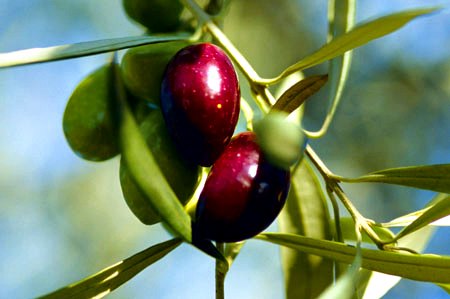
The olives need to be harvested by hand. Only fully ripe, undamaged olives are suitable for the very best oil. Split, unripe or over-ripe olives reduce the fruitiness of the oil and contribute to its bitterness. Following a thousand-year tradition, men knock the branches of the olive tree with long sticks, in a process called vareo. (You can see a woodcut of this process on the Señorío de Vizcántar tin). The ripe fruit falls into nets that have been spread out at the base of the tree. To produce some of the very finest oils, each olive is picked by hand. Mechanical means are never used for quality olive oil because they bruise the fruit and hurt the trees. Windfall olives that are usually overripe or bruised and only used for bulk oil.
 |
Duo of 'First Day of Harvest' Extra Virgin Olive Oils: This spectacular pair of extra virgin oils comes exclusively from olives cold pressed on the very first day of the harvest. Brilliant green and bursting with bright fresh olive flavor, both of these delicious oils are among the best we have ever tried. |
The harvested olives need to be processed promptly within 72 hours of being picked. Most of the Tienda olive oils were processed the same day. First, large blowers remove leaves and twigs. Then, if it is to be blended oil, different varieties of olives are mixed together (in contrast to single fruit oil). Next, the olives with their pits intact are ground to a paste by granite rollers, or by a worm gear mechanism.
Traditionally, cold-pressed olive oil was produced by hydraulically pressing the ground olive mash between circular mats -- once made of esparto grass. Today, centrifuges are often used. The important factor is that the juice obtained as gently as possible without generating heat which reduces the flavor and nutrient content of the oil. From the centrifuge the oil is passed through a series of large settling tanks, and eventually placed
See also
- Which olive oil should I choose?
- A common sense guide to olive oil
- Olive oil: Reading the label
- How healthy is olive oil?
- The olives behind the oils
- Tasting olive oil
- The ugly truth about Italian olive oil (NY Times article)
You may be also interested in...
Our olive oil selection
We have listed below all of the olive oils that we carry, along with descriptions of their flavors and uses.
|
Product |
Olive varieties and origin |
Flavor |
Recommended for | ||
|
100% cold pressed Arbequina olive oil from Catalonia |
Silky, smooth oil with no bitterness. Flavors of almonds and dried fruit |
Fresh crusty bread for dipping; garden salad with tomatoes | ||
|
Picudo, Hojiblanca and Picual from Cordoba |
Complex warm and fruity flavor. First cold pressed - very low acidity |
Green salads and dipping with crusty bread; good for cooking meats, stews, seafood and sautés. | ||
|
Balanced blend of Arbequina and Empeltre from Aragon |
Medium - fruity and flavorful |
Dip some crusty bread in it, or adorn a salad bowl of baby greens | ||
|
100% cold pressed Arbequina olive oil from Catalonia |
It has delicate flavors of green apples, herbs and roasted almonds |
It is the perfect pairing for fresh greens, sautéed garden vegetables or warm baked bread | ||
|
Nevadillo Blanco, from Sierra Morena in Andalusia |
Fruity flavor, smooth texture, with peppery finish |
Perfect oil for crusty bread and salad greens | ||
|
Arbequina from Andalusia |
Fresh, fruity and bursting with flavor |
Enjoy it on its own, with a loaf of fresh or toasted bread | ||
|
Coupage of Hojiblanca and Arbequina oils from Castilla-la Mancha |
Buttery and mild with herbal, nutty flavors |
Perfect for fresh salads and for sauteing vegetables and seafood. |


Product of the month |
Recent Articles


-
Lacon con Grelos - Boiled Ham with Greens
Oct 25, 17 06:18 AM
 In Galicia, the meat used for this recipe is the lower portion of the front pork leg, or hock, and it's salt cured. I prepare it with fresh hocks, and it's also delicious.
 -
Esqueixada
Aug 31, 17 06:20 AM
 Esqueixada is a quintessential Catalan salad. The main ingredient is always cod. Some versions also include green bell peppers; others eliminate the peppers altogether
 -
Spanish Salads - Ensaladas
Feb 09, 17 05:26 AM
 DURING THE HOT summer months, Spaniards look forward to their cuisine’s rich array of cold soups and salads.