What can I learn from the label of an olive oil container?
"Extra Virgin" is the highest quality. It is always cold-pressed which means that the olives did not lie around indefinitely before pressing, which may be the case for supermarket grade oils which may include oil from olives that have dropped onto the ground.
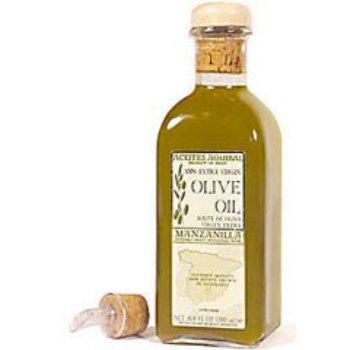
The acidity level is never higher than 1% (1 gram fatty acid per 100 grams of oil) which refers to the proportion of oleic acid, a monounsaturated fatty acid in the oil: the lower the acidity, the finer the oil -- up to a point. The difference between .02% and .03% is indistinguishable. High acidity is produced when the oil is made of the olives that have dropped from the tree and have burst open on the ground; or if the fruit is stored too long before pressing.
 |
Can Solivera Wild Extra Virgin Olive Oil: This precious organic wild olive oil may well be the best you have ever tasted. It is extracted using the same process as was used in the Middle Ages. The process is half as efficient as a centrifuge, the modern technique used for virtually all other olive oils. But the oil is the ultimate: fragrant and flavorful and natura |
"Pure" olive oil is refined so that all impurities have been removed - along with its flavor (like distilled water). They then add some extra virgin oil to give it some taste. This cheaper oil is only suitable for frying.
If the label says "first cold pressing" you know that it is 100% extra virgin olive oil, not processed or pasteurized
Of course, all olive oil is filtered to some extent to remove unwanted residue such as leaf fragments. If the label says, "unfiltered", it means that filtering is held to a minimum, so that minute particles of olive will remain thereby enhancing the flavor of the oil. After a time they may settle to the bottom of the bottle.
Finally, the labels of some unique olive oils proudly bear the term "D.O." or "Denominación de Origin" followed by the name of a town or region, such as Nuñez de Prado, D.O. Baena; Señorío de Vizcántar, D.O. Priego de Córdoba or Mas Tarrés Extra Virgin Olive Oil PDO Siurana. This is a government controlled official designation to assure you that the product is authentic. The raw materials are produced within a specific geographical area; the distinctive qualities and characteristics are due mainly to the natural environment; and the manufacture of the product follows strict guidelines.
France has a similar system which assures you that a bottle of wine designated "Chateau Yquem" is really from Yquem; or that Roquefort cheese comes from that area and the cheese is formed in the traditional way; or that Champagne is really made in the region of France that originated this kind of wine.
You may be also interested in...
See also
- A common sense guide to olive oil
- How healthy is olive oil?
- What factors make the best olive oil?
- The olives behind the oils
- Tasting olive oil
- The ugly truth about Italian olive oil (NY Times article)
Our olive oil selection
We have listed below all of the olive oils that we carry, along with descriptions of their flavors and uses.
|
Product |
Olive varieties and origin |
Flavor |
Recommended for | ||
|
100% cold pressed Arbequina olive oil from Catalonia |
Silky, smooth oil with no bitterness. Flavors of almonds and dried fruit |
Fresh crusty bread for dipping; garden salad with tomatoes | ||
|
Picudo, Hojiblanca and Picual from Cordoba |
Complex warm and fruity flavor. First cold pressed - very low acidity |
Green salads and dipping with crusty bread; good for cooking meats, stews, seafood and sautés. | ||
|
Balanced blend of Arbequina and Empeltre from Aragon |
Medium - fruity and flavorful |
Dip some crusty bread in it, or adorn a salad bowl of baby greens | ||
|
100% cold pressed Arbequina olive oil from Catalonia |
It has delicate flavors of green apples, herbs and roasted almonds |
It is the perfect pairing for fresh greens, sautéed garden vegetables or warm baked bread | ||
|
Nevadillo Blanco, from Sierra Morena in Andalusia |
Fruity flavor, smooth texture, with peppery finish |
Perfect oil for crusty bread and salad greens | ||
|
Arbequina from Andalusia |
Fresh, fruity and bursting with flavor |
Enjoy it on its own, with a loaf of fresh or toasted bread | ||
|
Coupage of Hojiblanca and Arbequina oils from Castilla-la Mancha |
Buttery and mild with herbal, nutty flavors |
Perfect for fresh salads and for sauteing vegetables and seafood. |


Product of the month |
Recent Articles


-
Lacon con Grelos - Boiled Ham with Greens
Oct 25, 17 06:18 AM
 In Galicia, the meat used for this recipe is the lower portion of the front pork leg, or hock, and it's salt cured. I prepare it with fresh hocks, and it's also delicious.
 -
Esqueixada
Aug 31, 17 06:20 AM
 Esqueixada is a quintessential Catalan salad. The main ingredient is always cod. Some versions also include green bell peppers; others eliminate the peppers altogether
 -
Spanish Salads - Ensaladas
Feb 09, 17 05:26 AM
 DURING THE HOT summer months, Spaniards look forward to their cuisine’s rich array of cold soups and salads.